
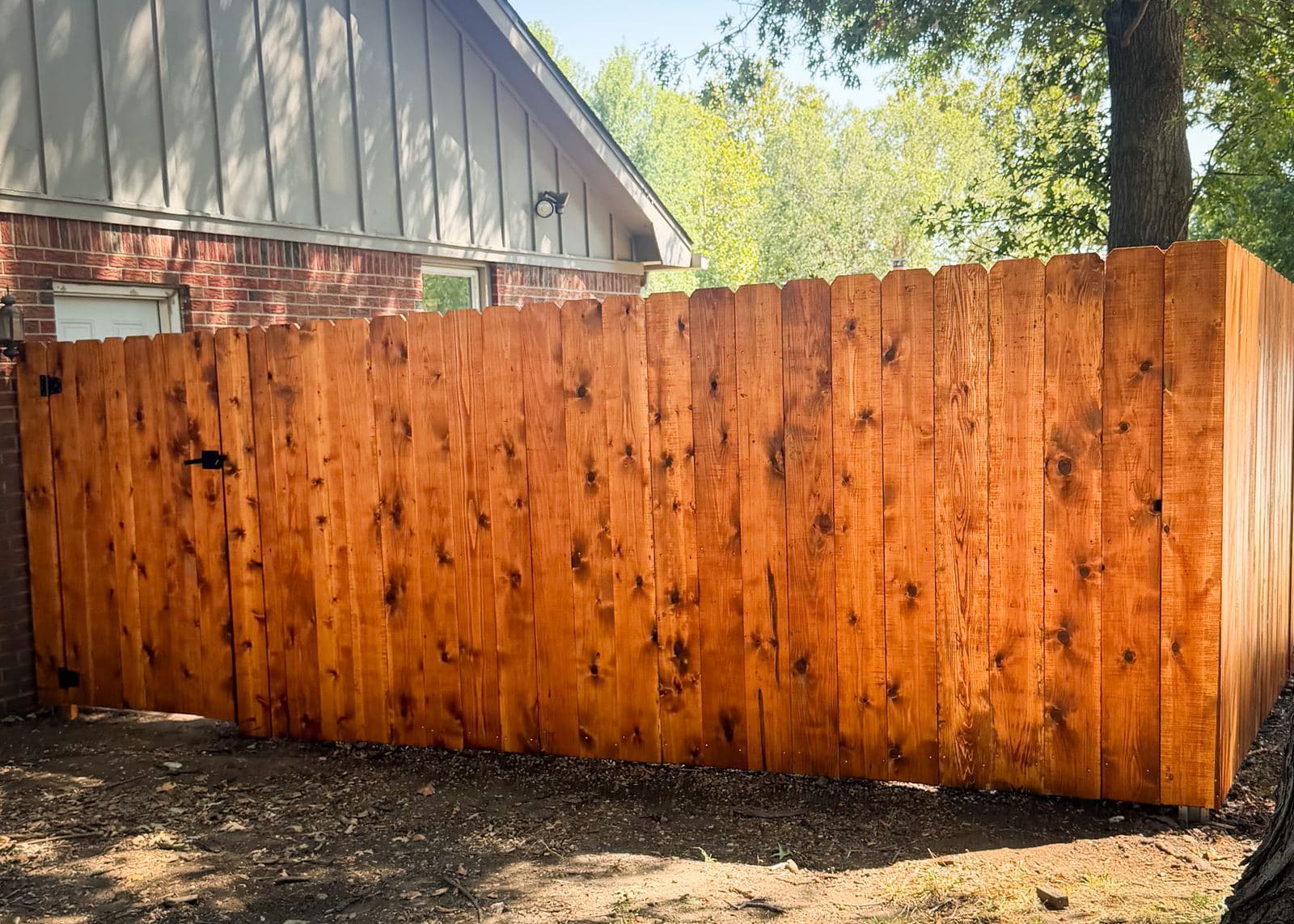
For most Wichita dogs, the best fence is a 6 ft cedar or vinyl privacy fence on steel posts. Add a kickboard if your dog digs. Keep horizontal rails off the dog's side if your dog climbs. A solid fence also blocks the view of the street, and a dog that can't see the mail carrier has a lot less reason to go over.
We build cedar, vinyl, chain link and ornamental iron, and a dog is the reason for a lot of our jobs. Here's how we match the fence to the dog.
How tall should a fence be for my dog?
- Small dogs that don't jump: 4 ft usually holds them. The gaps matter more than the height.
- Medium dogs: 5 ft is the in between. We'd still lean 6 ft if they've ever cleared something.
- Big dogs and jumpers: 6 ft. A big dog that really wants out can often clear 4 ft.
Wichita zoning lets a backyard fence go up to 8 ft, so 6 ft is well inside the rules. Near a street or a driveway, a solid fence has to drop lower. That's in our Wichita fence permit guide. Suburbs and HOAs can set their own rules, so check before you pick.
How do I keep my dog from digging under the fence?
Start with a kickboard. That's a board run along the bottom of a cedar fence, right at the dirt. It closes the gap under the pickets and gives a digger a hard edge instead of a soft one.
For a serious digger, add a buried wire mesh apron. It's a strip of wire laid flat under the dirt along the inside of the fence line. The dog digs, hits wire, and gives up. Most dogs dig right at the base of the fence, not a foot back, so the apron is where they start.
Where the bottom of the picket lands is also your call. We give two options at the sale: flush to grade, or about 1.5 inches above it for airflow. If a dog is the reason for the fence, go flush. On a sloped yard, a racked fence follows the ground and skips the triangle of daylight a stepped fence leaves under each section.
How do I stop my dog from climbing the fence?
Take away the ladder. A wood privacy fence has rails on one side, and a dog that climbs will use them as steps. Put the smooth, finished face toward your yard and the rails toward the neighbor. Which side gets the finished face is one of the things we write down at the sale, so tell us about the dog before it's decided.
Solid vinyl privacy panels give a dog very little to grab. Chain link is a different story. Some dogs learn to climb the mesh like a ladder. If yours is a climber, a cedar privacy fence or vinyl fence is the better pick.
How small a gap can a small dog squeeze through?
Smaller than you think. If a small dog's head fits through a gap, the body usually follows. A privacy fence doesn't have that problem, because there's no gap between pickets to push through. Spaced pickets and standard ornamental iron panels do.
Check under the gate too. That's the gap small dogs find first.
What gate latch keeps a dog in?
Most dogs don't get out over the fence. They get out through the gate. Somebody leaves it open, or it doesn't quite catch. A gate that swings shut on its own and latches itself fixes most of that. Self closing hinges and a self latching latch are worth asking for on any dog yard.
A gate is also the part that sags first on a cheap fence. It hangs on terminal posts, and on our cedar jobs those are steel, set 30 inches deep in concrete. A gate that sags drags, and a gate that drags doesn't latch.
Is chain link a good fence for dogs?
It's the budget option, and it works for a lot of dogs. It has no gaps to slip through and it's the cheapest way to close in a big yard. We use 9 gauge fabric, a top rail so the fence doesn't fold when a dog puts its paws up, and a tension wire at the bottom that pulls the fabric down to grade. Details are on our chain link and ornamental iron page.
The tradeoffs: a dog can see right through it, which winds up some dogs, and climbers can climb it.
What about ornamental iron with a dog?
Ornamental iron looks great in a front yard, but a small dog can walk right through a standard panel. That's what puppy pickets are for. They double the picket count through the lower part of the panel. Put them on the runs the dog actually uses and leave the rest standard, so you're not paying for them around the whole yard.
What does Wichita law say about keeping a dog in?
Wichita's animal code defines running at large as any animal, other than a cat, "that is not confined within a fenced enclosure or shelter capable of preventing the animal from exiting at will, unless under the control of a person, either by lead, cord, rope or chain" (Wichita Code 6.04.010). An owner whose animal is found running at large in the city "shall be deemed guilty of a misdemeanor" (Wichita Code 6.04.040).
Read that first part again. A fence your dog can jump, dig under or squeeze through isn't "capable of preventing the animal from exiting at will." In the city's eyes, the fence has to actually work.
Two rules cover electric options, and they point different ways. The animal code says a dog isn't running at large when it's on the owner's property and "confined by an operating electronic fencing system," as long as the premises are "clearly and prominently marked" and the dog wears the working parts of the system (6.04.010). The fence code says "Electrically charged fences and barbed-wire fences are prohibited in all residential zoning districts," with a few narrow exceptions (Wichita Code 5.35.010). So a hot wire along the top of your fence is out. If you're not sure which one a product counts as, ask the city before you buy it.
We build fences. We're not lawyers. That's the code text as posted on Municode in September 2026.
How do we build a fence for a dog?
- Galvanized steel posts on cedar, set 30 inches deep in concrete
- Stainless steel ring shank fasteners, two per rail, so pickets don't back out when a dog leans on them
- 7/8 inch thick cedar pickets, about twice the wood of a standard board
- A steel pipe inside every vinyl post
- Picket bottom, finished face and gate swing picked with you at the sale, and initialed
- 2 to 3 days on site for a typical job
We're insured, we pull permits on every job that needs one, and we call 811 before we dig. The rest of how a job runs is on our fence installation in Wichita page.
Dog fence questions, answered
What is the best fence for dogs in Wichita?
For most dogs, a 6 ft cedar or vinyl privacy fence on steel posts. Add a kickboard for diggers and keep horizontal rails off the dog's side for climbers. Chain link is the budget option, and ornamental iron works with puppy pickets.
What is the best fence for dogs that dig?
A privacy fence with the picket bottom set flush to grade, a kickboard along the bottom, and a buried wire mesh apron laid flat along the inside of the fence line. On chain link, a bottom tension wire pulls the fabric down to grade.
What is the best fence for dogs that jump or climb?
A 6 ft solid privacy fence with the smooth face toward the dog, so there are no rails to use as steps. Chain link is easier for a determined climber to get up.
Are electric fences legal in Wichita?
Wichita Code 5.35.010 says electrically charged fences are prohibited in all residential zoning districts, with narrow exceptions. Separately, Wichita Code 6.04.010 says a dog confined on the owner's property by an operating electronic fencing system isn't running at large, if the premises are clearly and prominently marked and the dog wears the working parts of the system. Ask the city if you're unsure which rule a product falls under.
Does Wichita require a fence for dogs?
Not a fence by name. Wichita's code makes it a misdemeanor for an animal other than a cat to run at large, and an animal is running at large unless it's in an enclosure capable of keeping it from getting out at will, on a lead, or covered by one of the code's exceptions.
Got a digger, a jumper or an escape artist? Tell us about the dog on the yard walk. We'll build the fence around it.