
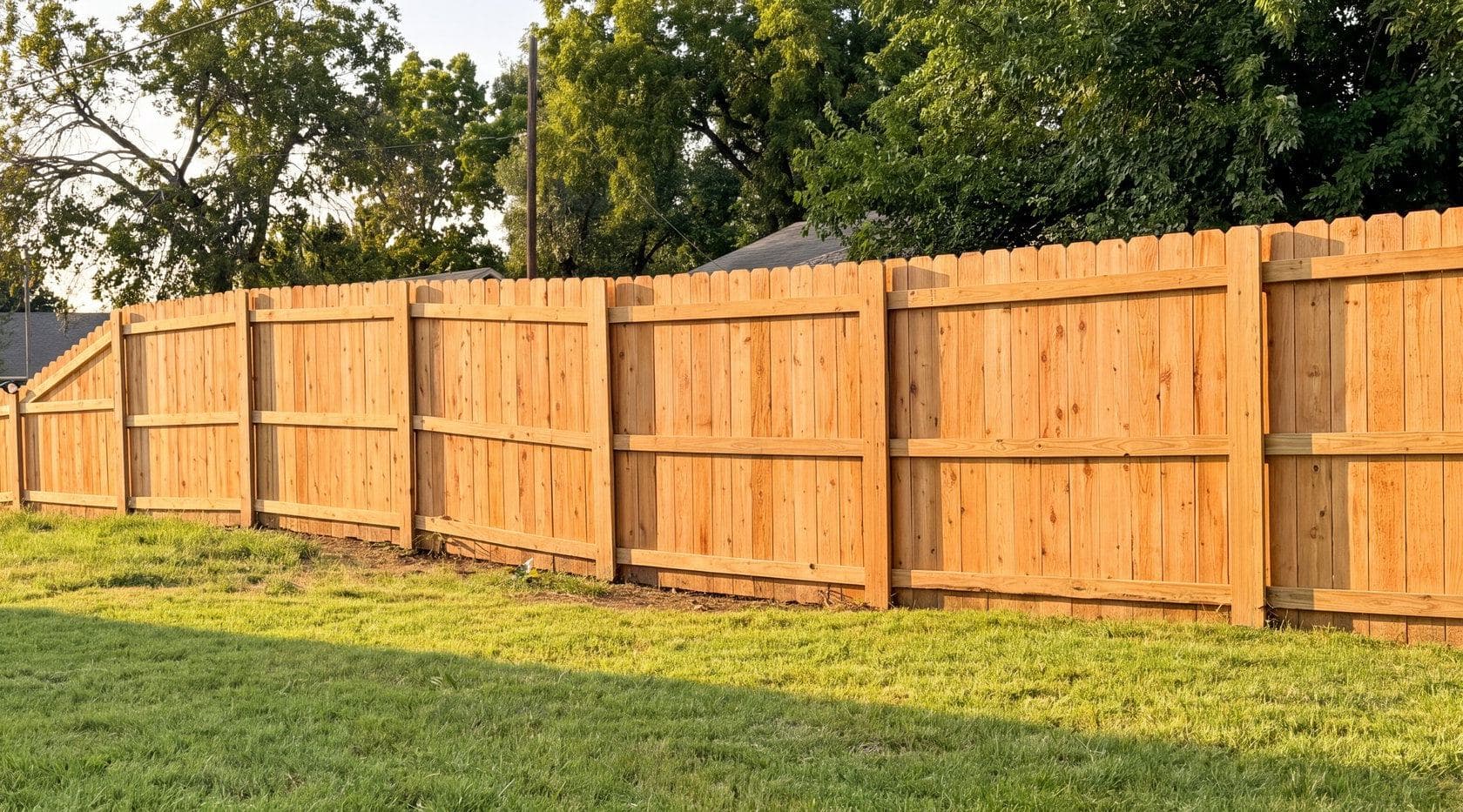
Ovora vs a Typical Fence Contractor
Ovora vs. a Typical Wichita Fence Contractor: What Actually Differs
Most crews in the Wichita metro build to the same unwritten standard. Ovora builds to a written one — and publishes it, line item by line item, so you can hold it against the bid sitting next to ours.
Short version
Most fence crews in the Wichita metro build to the same unwritten standard — one bag of concrete a hole, a wood post in the ground, a 5/8-inch picket off the big-box rack, boards butted edge to edge. Ovora builds to a written one: 1.5 to 2 eighty-pound bags per hole, a galvanized steel post concealed inside every cedar fence, a 7/8-inch-thick by 8-inch-wide cedar picket, board-on-board overlap available when you never want a sightline gap, driven-post installation available with no concrete at all, and a one-year warranty on our own workmanship. Everything below is the specific difference, with sources. If you want a cheaper fence, plenty of good people will build you one. If you want the fence standing plumb in fifteen years, this is what goes into it.
What does a typical fence bid leave out?
Line locates, picket size, and gate hardware are the three items that quietly separate a low bid from a real one. Ovora calls 811 before every dig, and the picket size is written on the quote in inches, instead of left to the yard. When staining is part of the job, we use Wood Defender — an oil-based penetrating stain that, per the manufacturer, will not peel, crack or blister as it ages (Wood Defender FAQs). Staining is an option you choose, not something we assume, and it’s priced on the quote either way, never raised after the fence is up. None of that shows up as a line item on a bid that doesn’t carry it.
Line by line
What a typical Wichita-area fence bid includes vs what Ovora builds to
| Line item | Ovora OutdoorOur written standard | Typical Wichita-area bid |
|---|---|---|
| Concrete per hole | 1.5–2 bags of 80-lb mix | About 1 bag |
| Post depth | 30″, per the post manufacturer’s published spec | Often 18–24″ |
| Cedar-fence post | Concealed galvanized steel (PostMaster+) | Treated 4×4 wood |
| Cedar picket | 7/8″ thick × 8″ wide — about 2× the cross-section | 5/8″ × 5-1/2″, the big-box standard |
| Board coverage | Full-dimension boards set tight; board-on-board overlap available | 5-1/2″ big-box boards, thinner stock |
| No-dig option | Default on vinyl; cedar is set in concrete | Rarely offered |
| Vinyl compound data | Published cell class and property values | Usually unpublished |
| Warranty labor (material) | Covered by the manufacturer we install | Commonly excluded |
| Warranty on installation | 1 year on workmanship | Varies, often unstated |
| 811 locate | Called on every job | Assumed |
| Stain on cedar | Optional — Wood Defender, oil-based, named and priced on the quote | Varies; the product is usually unnamed |
| Layout decisions on the quote | Section layout, picket face, picket bottom, slope, gate swing and latch — chosen and initialled at the sale | Rarely listed; decided in the yard on the day |
| Fasteners | Stainless steel ring-shank, two per rail, staggered high and low | Smooth-shank gun nails; the metal is usually unspecified |
Scroll the table sideways to see every column →
How much concrete should actually go in a fence post hole?
About two eighty-pound bags per hole — not one. A 10-inch-wide hole dug 30 inches deep holds roughly 1.36 cubic feet, or about 1.15 cubic feet once the post displaces its share. An 80-pound bag of concrete yields about 0.6 cubic feet. That is 1.9 bags for a single properly filled hole. Ovora’s standard is 1.5 to 2 bags of 80-pound mix per post.
Read the full breakdown
This arithmetic is easy to check on any bid in town. Pour one 80-pound bag into a 10-inch hole and it fills 13 inches of depth. The remaining 17 inches are backfill dirt. That fence is not held by concrete; it is held by loose soil, and Kansas soil moves.
| Hole size | Concrete needed (net of post) | 80-lb bags | 60-lb bags |
|---|---|---|---|
| 10″ × 27″ | 1.04 cu ft | 1.7 | 2.3 |
| 10″ × 30″ — Ovora standard | 1.15 cu ft | 1.9 | 2.6 |
| 12″ × 27″ | 1.58 cu ft | 2.6 | 3.5 |
| 12″ × 30″ | 1.75 cu ft | 2.9 | 3.9 |
Scroll the table sideways to see every column →
Volumes calculated from hole dimensions; bag yields per Bob Vila’s concrete-per-post guide. Ovora digs 10 to 12 inches wide and sets posts 30 inches below the surface, which is the depth Master Halco publishes for the steel post we use.
Does a hidden steel post inside a cedar fence actually matter?
Yes — it is the difference between a fence that fails at the post and a fence that only ever needs a board replaced. Ovora sets a galvanized steel post inside every cedar fence, concealed so the finished fence reads as all wood. A wood post rots at grade, where wet soil meets air. A galvanized steel post has nothing there to rot.
Read the full breakdown
The published spec on the post we use, the Master Halco PostMaster+: 4-1/2″ × 1-1/2″ line post at .100″ wall, 3″ × 3″ corner post at .12″ wall, G90 zinc coating at 0.90 oz/ft², 50,000 psi yield strength, a 6″–10″ hole diameter and 30″ embedment depth, concrete at a minimum 3,000 psi 28-day compressive strength, and a residential lifetime limited warranty tied to owner tenure (Master Halco PostMaster+ specifications). The steel carries the wind load; the cedar carries the look. Most crews in this market still set a treated 4×4 and ask the wood to do both jobs. See how it goes together on our privacy fence page.
What size cedar picket does Ovora use, and how many go on a section?
A 7/8-inch-thick, 8-inch-wide cedar picket — full-dimension boards, with board-on-board overlap available as an upgrade when you never want a sightline gap, even as cedar ages. The standard picket in this market, the one both big-box chains stock and the one most bids quietly assume, is 5/8 inch thick and 5-1/2 inches wide (Home Depot, Lowe’s). That is a quarter inch thicker and two and a half inches wider per board — roughly twice the cross-section of wood in every picket on the fence.
Read the full breakdown
A wider, thicker board does real work on a Kansas fence line: fewer board edges per hundred feet means fewer places for a gap to show, and more wood left holding the fastener after a decade of expanding and contracting. It also cups and checks less as it dries through its first Kansas summer — none of it a marketing distinction, all of it measurable with a tape at the fence line. Cedar shrinks across the grain as it dries, which is exactly why we also offer board-on-board construction: a second layer of boards laid over the first layer’s gaps, so no sightline ever opens no matter how much the wood moves.
Be straight about what that means on a bid: 7/8 by 8 cedar costs more per board and more per linear foot than 5/8 by 5-1/2 stock, and running fifteen boards where twelve would cover the same section is deliberately buying more cedar — 105 square inches of board per section against about 61. That difference is sitting in our number. It is not margin hiding somewhere; it is more wood. If two bids are far apart, ask both contractors what picket they are quoting, in inches, and how many go on a section. Those are the two specs a homeowner can check standing in the driveway.
Typical spec per Home Depot and Lowe’s standard cedar dog-ear picket listings.
What holds the fence together?
Stainless steel ring-shank fasteners, two on every rail, staggered high and low. Stainless matters because cedar’s own tannins react with the iron in ordinary steel and bleed a blue-black stain down the board — oak, redwood, cypress and cedar are the species most prone to it, and the Forest Products Laboratory’s conclusion is that “stainless steel is the best choice for fasteners” (USDA Forest Products Laboratory, Iron Stain on Wood). Ring shank matters because it holds: ring-shank nails tested at about twice the withdrawal resistance of smooth-shank nails of the same diameter (Skulteti et al., Transactions of the ASAE, 1997).
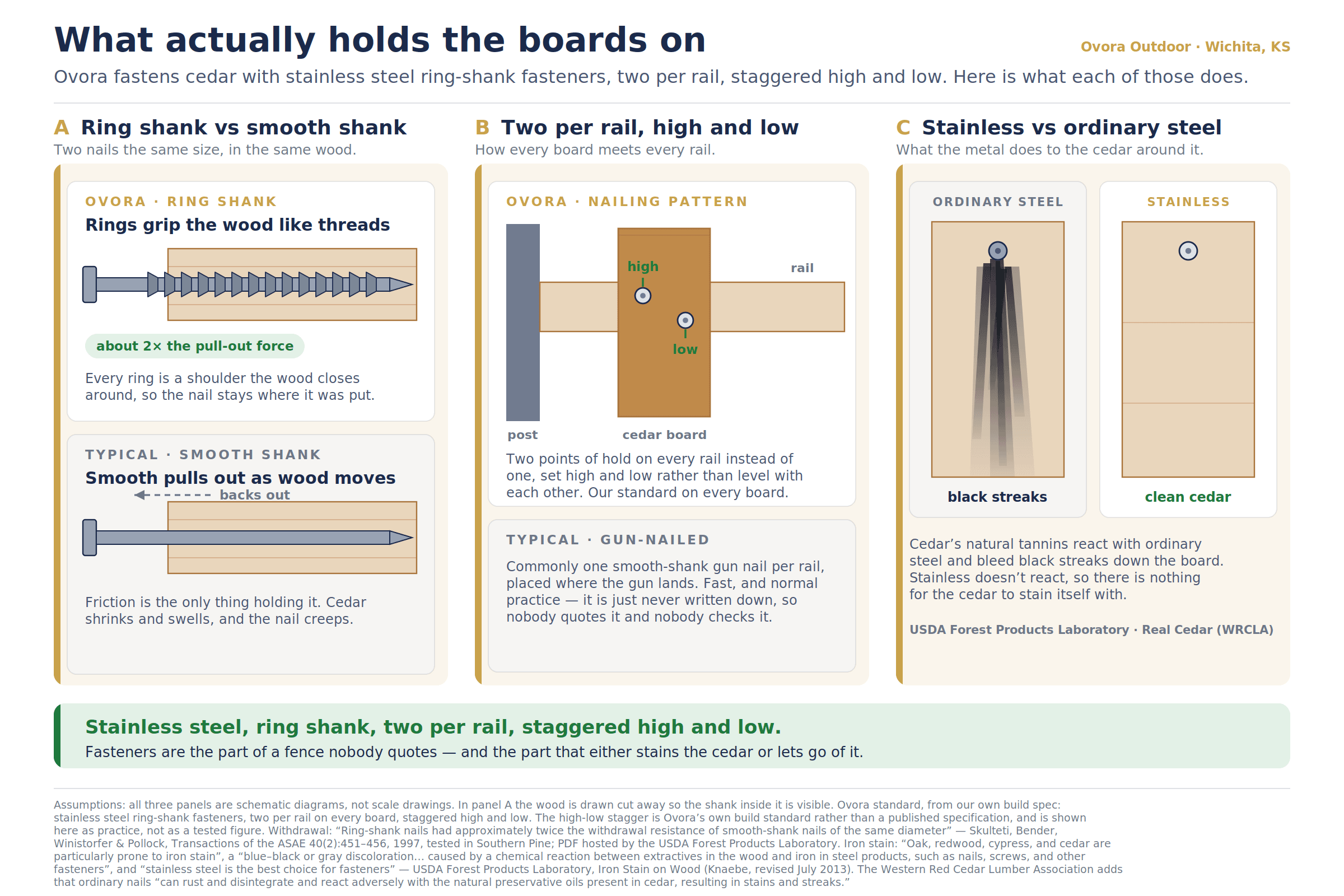
Withdrawal figure per Skulteti et al. (1997); iron-stain figures per the USDA Forest Products Laboratory and the Western Red Cedar Lumber Association.
What do you get to choose about how the fence is laid out?
Six things, and you choose them before the crew shows up rather than while they are working. Ovora runs a written decision guide at the sale that records how the run is divided into sections, which side of the fence gets the finished face, where the bottom of the picket lands, how any slope is handled, which way each gate swings, and which latch goes on it. You initial the sheet, and it goes to the crew as the record of how the job was sold. On a typical bid none of those six appear anywhere — they get settled in the yard, by whoever is holding the nail gun, on the day.
Read the full breakdown
How the run is divided. Fence sections run about 8 feet. A yard almost never divides evenly into full 8-foot sections, and what happens to the leftover makes a finished fence look intentional or improvised. Ovora spreads the leftover across the last three sections instead of dumping it into one odd panel — no random short 2-to-3-foot section at the end of a run, no stretched-out one-off, a layout decision made at the sale, not a problem discovered at the last post.
Which side gets the finished face. A privacy fence has a finished side — the smooth picket face — and a structural side, where the rails and posts show; only one side of the property gets the finished face. Pickets facing out, so the neighbour or the street gets it, is the most common choice; pickets facing in gives it to your own yard. It can also vary by side of the property, worth deciding on purpose, not by default, especially along a line you share with a neighbour.
Where the bottom of the picket lands. Two options, both standard: flush to grade, or raised about 1.5 inches above grade for more airflow and clearance from moisture. Neither is an upgrade or the “right” choice — it’s a preference call, on the sheet, so it’s yours, not the crew’s habit.
How slope is handled. If the yard has any fall to it, a fence can follow the ground two ways. Stepped keeps every section level and steps down the hill in stages. Racked, or contoured, angles the rails to follow the grade continuously while the pickets stay plumb. Neither is better than the other; they simply look different, and you pick the look. Flat lots skip the question.
Gates. Swing direction is yours: toward the house or yard side, which usually clears a walkway or patio, or toward the neighbour’s or street side, which keeps the swing out of your own yard. If the job has more than one gate, the swing is recorded for each one separately. Latch is a second, separate choice — the standard gravity/thumb latch is included in the base gate price and covers most jobs; self-closing spring, magnetic, and keyed lockable latches are available per gate as an upcharge. The self-closing spring latch is the one to raise if a pool or a pet requirement means the gate has to close itself.
Ovora writes these six down at the sale, prices anything that carries an upcharge, and has you initial and date the sheet with the salesperson before any material is ordered.
What is no-dig (driven post) installation, and when is it the right call?
No-dig means the post is driven into undisturbed soil with a hydraulic pounder instead of a concrete footing. Nothing is excavated, nothing cures, and the fence can be finished the same day. Ovora runs driven pipe as the default on vinyl. Cedar is always set in concrete. Concrete also stays our recommendation on rocky ground, on heavy-wall posts, and on the most wind-exposed lots.
Read the full breakdown
The reason driven posts hold is counterintuitive. A dug hole permanently destroys the soil column around the post, and backfill never regains the density of what came out. A driven post is gripped along its whole embedded length by soil that was never disturbed. It also sidesteps the classic concrete failure mode: a collar that traps water against the post and cracks with frost.
| Criterion | Concrete-set post | Driven (no-dig) post |
|---|---|---|
| Soil disturbance | Hole excavated, backfill replaced | None — post driven into undisturbed soil |
| Cure time before fence hangs | Yes — concrete must set | None; same-day completion |
| Rocky or shallow-bedrock ground | Preferred | Often not possible |
| Frost-heave path | Concrete collar can lift as a unit | No collar to lift |
| Repair or relocation | Break out the footing | Post extracts and resets |
| Best for | Rocky ground, heavy-wall posts, maximum wind exposure | Most Wichita-metro clay and loam lots |
| Ovora practice — cedar | Always | Not offered |
| Ovora practice — vinyl | Used where conditions require it | Default |
Scroll the table sideways to see every column →
Neither method is universally better — any contractor who tells you otherwise is selling you their equipment. What matters is you’re offered both, and told why. One firm rule on our side: the .280 heavy-wall vinyl post we specify for open country with no south or west windbreak cannot be driven, so those jobs get concrete.
How do the warranties compare, and who pays the labor?
Ovora warranties its own workmanship for one year from installation, and the vinyl we install carries a manufacturer warranty that pays reasonable labor to put replacement material up. Most vinyl sold in this market carries a lifetime warranty that explicitly excludes labor — free parts, and a bill to install them. That distinction lives in the warranty document, not the sales pitch, and it is where the money actually is.
Read the full breakdown
Nebraska Plastics, which makes Country Estate Fence, states it furnishes replacement materials and covers “reasonable labor charges necessary to install the replacement materials,” under a 50-year or limited lifetime residential warranty, non-prorated (Country Estate warranty). The vinyl most commonly quoted against us in this market states in its own warranty document that labor is not included, and that removal, disposal and reinstallation costs are the customer’s (competitor vinyl warranty PDF). Both exclude wind, hail and tornado damage, which is a reminder that in Kansas the installation is the warranty. The full material breakdown is on our vinyl fence page.
Why does any of this matter in Wichita specifically?
Because Wichita fences fail at the footing, not at the face. The Wichita/Sedgwick County Unified Building & Trade Code, which adopts the 2018 IRC, lists a frost line depth of 24 inches and amends Section R403.1.4 to read that “all exterior footings shall be placed at least 24 (610 mm) inches below the undisturbed ground surface” (Wichita/Sedgwick County UBTC). Ovora sets fence posts to 30 inches — six inches past the depth the code requires of a building footing.
Read the full breakdown
Wind is the other half. The same code table lists a residential design wind speed of 76 mph, or a 90 mph three-second gust. Wichita Eisenhower National Airport recorded a 102 mph gust on 17 June 2025, the highest in its record (NWS Wichita top wind gusts). Real Kansas wind has already exceeded the code’s design basis. A post set in one bag of concrete at 18 inches isn’t engineered for that — it’s hoping.
Where does Ovora work, and what else do you build?
We work daily in Maize, Andover, Derby, Bel Aire and Wichita, and fence is the front door rather than the whole house. The same crew that sets your posts also builds the structures and hardscape that make the yard worth fencing.
Read the full breakdown
Fence styles beyond cedar and vinyl are on our chain link and ornamental iron page. Grading, patios and plantings are on landscaping and hardscaping, and pergolas, pavilions and shade structures are on outdoor structures. City-specific detail is on our Derby, Andover and Bel Aire pages.
Call (316) 640-1590 or email contact@ovoraoutdoor.com and we will walk your yard, measure the run, and show you the spec before you sign anything.
Last reviewed: August 13, 2026. We update this page when our build spec or a manufacturer’s published spec changes.
See the spec before you sign anything.
We walk the yard, measure the run, and price it at your table — itemized, in writing.