
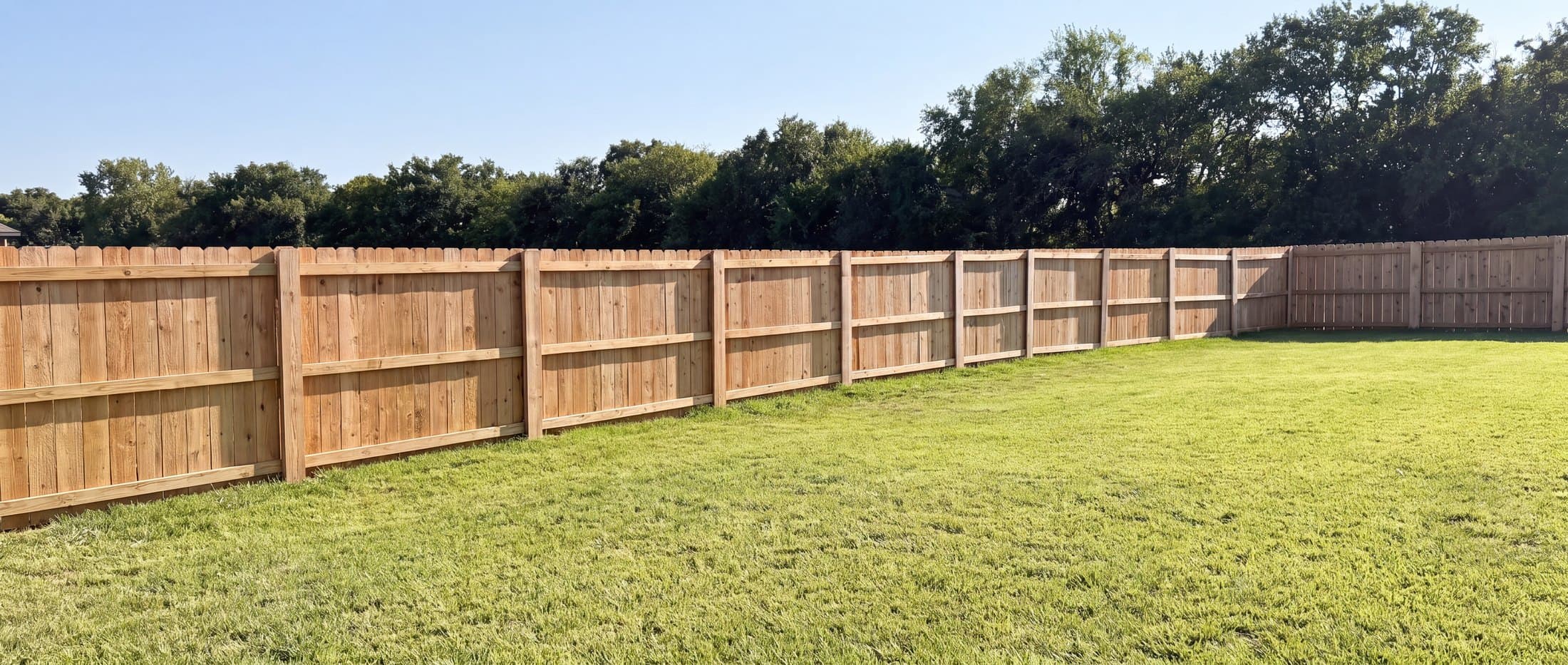
Cedar vs Vinyl in Kansas
Cedar vs. Vinyl Fence in Kansas: An Honest, Sourced Comparison
Cedar wins on cost, warmth and repairability. Vinyl wins on maintenance and on holding a straight line for decades. Both survive Kansas weather when the posts are right — and both fail when they are not.
Short version
Start with the money — it usually decides this. Industry cost guides and published Wichita-area contractor pricing put an installed 6-foot cedar privacy fence at roughly $30 to $55 per linear foot and vinyl privacy at $35 to $65 — on a 150-foot backyard, about $4,500–$8,250 against $5,250–$9,750. Kept stained, cedar lasts about 15 to 25 years in Kansas; vinyl runs 20 to 30 and asks for nothing but a hose. Whichever you pick, the post underneath decides the outcome: galvanized steel stays put in clay soil, wood does not.
One spec worth checking on any cedar bid: we build with a 7/8-inch-thick, 8-inch-wide picket, where the market standard is 5/8 by 5-1/2 — and board-on-board construction doubles the layer for a sightline that never opens as cedar ages. Below is the comparison with sources, including the part nobody publishes: how the two vinyl products actually sold here differ from each other.
Market ranges compiled August 2026 from HomeGuide, Angi and published Wichita-area contractor pricing — every source is listed on our Wichita fence cost guide. These are market figures, not Ovora’s prices.
Which lasts longer in Kansas weather, cedar or vinyl?
Vinyl lasts longer with no maintenance; cedar lasts a long time with maintenance, far less without it. Wind, ultraviolet load, and freeze-thaw at the footing decide the outcome — not the panel material. A cedar fence on steel posts and a vinyl fence on driven pipe will outlast a top-shelf panel bolted to a wood post in one bag of concrete.
Read the full breakdown
Wichita is a hard test. Eisenhower National Airport recorded a 102 mph gust on 17 June 2025, the highest in its record (NWS Wichita) — against a residential design wind speed of 76 mph, or a 90 mph three-second gust, in the adopted local code (Wichita/Sedgwick County Unified Building & Trade Code). That same code lists a frost line depth of 24 inches. Normal annual precipitation is 34.31 inches with 12.7 inches of snow (NWS Wichita climate normals, 1991–2020). Hard wind, wet-dry clay cycling and a real frost line: that combination is what breaks fences here.
Side by side
Cedar vs vinyl fence, criterion by criterion
| Criterion | Cedar | Vinyl |
|---|---|---|
| Up-front cost | Lower | Higher |
| Maintenance | Restain every few years | Wash occasionally |
| Repair a damaged section | Replace individual boards | Replace panel components |
| Color over time | Silvers if left unstained | Holds color; quality depends on the UV package |
| Behavior in wind | Flexes; fasteners are the weak point | Rigid panel; the rail-to-post connection is the weak point |
| Behavior in cold | Unaffected | Impact resistance drops as temperature drops |
| Thermal movement | Minimal | About 0.55″ across a 96″ rail over a 130°F swing |
| Picket profile | 7/8″ thick × 8″ wide (Ovora’s cedar spec) | 7/8″ thick × 7″ wide (Country Estate Lakeland) |
| Finish | Wood Defender stain when staining is part of the job | None needed |
| Installation warranty | 1 year on Ovora’s workmanship | 1 year on Ovora’s workmanship |
| Material warranty | Not applicable | Manufacturer’s, 50 years to lifetime |
| Feels like | Natural, warm, changes with the yard | Clean, uniform, done |
Scroll the table sideways to see every column →
Ovora installs both. Cedar work is on our privacy fence page; vinyl is on our vinyl fence page.
Why does cedar hold up outdoors without chemical treatment?
Cedar heartwood contains natural extractives that resist fungal decay without pressure treatment — why cedar, not a treated commodity species, is the default wood fence material across the Plains.
Cedar’s real enemy in Kansas isn’t rot — it’s ultraviolet light and moisture cycling at the surface. Left bare, cedar silvers within a season or two and starts to check. Cedar’s tannins also react with the iron in ordinary steel and bleed a blue-black stain down the board — why Ovora fastens cedar with stainless steel ring-shank nails (USDA Forest Products Laboratory, Iron Stain on Wood). The Ovora vs a typical fence contractor page draws that, and the two-per-rail high-low pattern, panel by panel.
Does cedar picket thickness matter, and what is standard?
It matters, and it’s the easiest cedar spec to verify with a tape measure. Ovora builds with a 7/8-inch-thick, 8-inch-wide cedar picket. The standard picket in this market — what big-box chains stock and most bids quietly assume — is 5/8 inch thick and 5-1/2 inches wide (Home Depot, Lowe’s). A trade source puts the common range at 5/8 to 3/4 inch, with anything approaching a full inch treated as the durability-grade option (Magnolia Fence & Patio).
Read the full breakdown
| Picket | Thickness | Width | Cross-section area |
|---|---|---|---|
| Ovora cedar picket | 7/8″ | 8″ | 7.00 sq in |
| Standard big-box dog-ear picket | 5/8″ | 5-1/2″ | 3.44 sq in |
| Difference | +1/4″ | +2-1/2″ | 2.0× |
Scroll the table sideways to see every column →
Both boards compared end-on at true relative scale, per Home Depot and Lowe’s standard cedar dog-ear picket listings.
Thickness resists cupping and checking as a board dries through its first Kansas summer, and it’s what’s left holding a fastener after a decade of expanding and contracting. Width does different work: a wider board means fewer board edges on a hundred-foot fence, and when a sightline gap is never acceptable, our board-on-board style lays a second layer of cedar over the first layer’s gaps. The Ovora vs a typical fence contractor page draws that section board by board. Country Estate’s Lakeland picket, for scale, is also 7/8 inch thick at 7 inches wide — the thicker cedar board is in the vinyl profile’s class, not the big-box one.
7/8 by 8 cedar costs more per board and per linear foot than 5/8 by 5-1/2 stock, and fifteen boards where twelve would cover the section is more cedar again. That’s the price of the fence, not the margin — more wood, not more markup. If two cedar bids are far apart, ask what picket each is quoting, in inches. It’s the one number you can check standing in the driveway.
What stain does Ovora use on cedar, and why does it matter?
When staining is part of the job, Ovora uses Wood Defender fence stain — an option you choose, not something applied automatically, and priced on the quote either way, never raised after the fence is standing.
The product matters because of what kind of product it is. Wood Defender’s manufacturer states that “each of our products is an oil-based, penetrating formula” that “will not peel, crack, or blister as they age” (Wood Defender FAQs). A film-forming finish sits on top of the wood and eventually lets go in sheets; a penetrating oil goes into the wood and wears rather than fails.
Read the full breakdown
That difference repeats at the maintenance coat. Per the same manufacturer, “when a maintenance coat is necessary, another application of stain can be directly applied on the previous coat” — no stripping, no sanding, no reset to bare wood every few years. Wood Defender publishes a two-year warranty on its Transparent line and three years on its Semi-Transparent, and states properly applied product “can last up to double the manufacturer’s warranty,” with coverage of 100 to 200 square feet per gallon on Transparent and 150 to 250 on Semi-Transparent (Wood Defender product line, Transparent Cedar Tone product page). The Transparent formula also carries under 200 g/L VOC, below both the EPA’s 550 g/L limit and the stricter 250 g/L state limits.
Those are the manufacturer’s published numbers, not our opinion of them. We recommend staining up front: a cedar fence finished on day one, before the wood weathers open, is a different fence at year ten than one finished whenever the homeowner got to it. Whether we do that work or you do, the timing is the part that pays.
The part nobody publishes
How does Country Estate vinyl compare to the vinyl most competitors install?
They disclose opposite halves of the spec sheet. Country Estate — the line Ovora installs — publishes compound data, 100% virgin PVC, an ASTM cell classification and measured physical properties, plus full profile geometry for the Lakeland privacy system; its standard post wall goes to dealers, not the website. The vinyl most competitors quote publishes rail geometry and warranty terms, not compound composition, cell class, or picket thickness. The clearest practical difference is in the warranty: Country Estate’s covers reasonable labor to install replacement material; the competing line’s explicitly does not.
| Criterion | Ovora installs Country Estate (Nebraska Plastics) | Typical competitor vinyl |
|---|---|---|
| Material composition | “100 percent virgin PVC compounds,” rigid PVC homopolymer | Not published |
| UV package | “High level of Titanium Dioxide pigment throughout the entire extrusion” | Not published |
| Lead stabilizer | “Never have and never will use lead as a stabilizer” | Not published |
| ASTM cell classification | D-1784 14344B | Not published |
| Tensile strength | 6,500 psi | Not published |
| Flexural strength | 11,400 psi | Not published |
| Izod impact | 5.0 ft-lb/in @ 23°C; 2.0 @ 0°C | Not published |
| Privacy post size | 5″ × 5″ (Lakeland) | 5″ × 5″ |
| Picket profile | 7/8″ thick × 7″ wide (Lakeland) | Not published by the manufacturer; a dealer listing describes 7/8″ × 6″ tongue-and-groove boards on one of its privacy panels |
| Privacy rails | 2″ × 7″ top and bottom; 2″ × 6″ mid rail at 84″/96″ | Decorative 2″ × 7″ three-chamber; Standard 1¾″ × 7″ |
| Fence heights | 48″, 60″, 72″, 84″, 96″ | 4′ to 8′ |
| Post spacing | 8′ on center standard; 75″ on center at 96″ height | Not published as on-center spacing; catalog lists 6′ and 8′ panel widths |
| Standard post wall thickness | Approx. .135″ on the 5×5 post, per the manufacturer’s dealer spec sheet | Approx. .135″, per a dealer listing — the same figure |
| Heavy-wall post option | .280″ heavy wall, published for high-wind systems | Not published |
| Aluminum inserts | Not required on the Lakeland system | Not required on its decorative rail; one of its other privacy systems uses one in the bottom rail |
| Residential warranty | 50 years or limited lifetime, non-prorated | Transferable limited lifetime; 30 years for one transferee |
| Commercial warranty | 20 years, non-prorated | 30 years, non-transferable |
| Replacement labor | Covered — “reasonable labor charges necessary to install the replacement materials” | Not covered — labor, removal, disposal and reinstallation excluded |
| Warranty transfer | One transfer; register within 30 days, request within 10 years, $25 fee | Transfers once, 30 years from original purchase |
Scroll the table sideways to see every column →
Sources: Country Estate 3-part specification · Country Estate Fence Facts · Country Estate warranty · Country Estate high wind load systems · Lakeland privacy specifications · Catalyst product page · Master Halco 2025 product catalog · Master Halco specifications and data sheets · Catalyst warranty PDF. Post wall figures: both standard 5×5 posts run about .135 of an inch — ours from the manufacturer’s dealer spec sheet, theirs from a dealer listing, not manufacturer literature. The .280-inch heavy wall is published by the manufacturer. “Not published” means we couldn’t find the figure in that manufacturer’s public literature, not that the product lacks it. Both lines are made in the USA and both are legitimate products.
How thick is the plastic?
Vinyl fence parts are hollow — a post is a tube, like a square drinking straw. The wall is the whole post, so the first real question is how thick that plastic is. One thing trips people up: a “7/8-inch board” measures how deep the board is, front to back — not how thick the plastic wall is.
On a standard 5-inch post, the plastic runs about .135 of an inch — a shade over an eighth, or two quarters stacked. That’s the number for the line we install, and it’s also the number for the vinyl most competitors quote here. Wall thickness is not where vinyl brands split apart. Anyone claiming their standard post is way thicker than everyone else’s is either selling a heavy-wall post or guessing.
What actually makes one white fence different from another? Two things, neither on the outside.
What is in the plastic. Ours is 100% new PVC with sun protection mixed through the wall, not just on the surface, and the maker publishes its tested strength numbers. Competitors’ vinyl publishes none of that — not what’s in it, not one strength number. Same thickness, different plastic.
Who pays the labor when a panel fails. Ours does, in writing. Theirs explicitly doesn’t — a free part you still have to hire someone to install.
For windy jobs, the same maker builds a .280-inch heavy-wall post — about twice the standard — and that’s what we use in open country where nothing blocks the wind.
Thickness is where most vinyl is the same. Ask the two questions that actually tell brands apart: what is in the plastic, and who pays the labor on a warranty claim.
Does vinyl get brittle in Kansas winters?
Impact resistance drops as temperature drops — that’s measurable, not marketing. Country Estate publishes Izod impact of 5.0 ft-lb per inch at 23°C and 2.0 at 0°C, roughly a 60% reduction near freezing. It doesn’t mean the fence shatters — it means a January mower rock does more damage than a July one, and it’s a reason to care about the compound, not the color.
Read the full breakdown
The other cold-weather number that matters is thermal movement. At Country Estate’s published coefficient of 4.4 × 10⁻⁵ in./in./°F, a 96-inch rail moves about 0.55 inch across a 130°F surface-temperature swing — a real Kansas range between a January night and an August afternoon on a south-facing white rail. Vinyl systems handle that with routed post pockets that let the rails float; a rail screwed rigid at both ends bows — an installation decision, not a product one.
Can cedar and vinyl both be installed without concrete?
Yes. Vinyl goes on driven steel pipe as our default; cedar offers driven posts as an option. Concrete stays the call for rocky ground, heavy-wall posts, and the most wind-exposed lots — open country with no windbreak, where the .280 heavy-wall post we specify can’t be driven at all.
Read the full breakdown
Driven posts skip the excavation entirely: the pipe goes into undisturbed soil, which grips along the full embedded length instead of backfill that never regains its original density. Nothing cures, so the fence finishes the same day. Concrete’s advantage is mass and predictability in ground that won’t accept a driven post.
| Criterion | Concrete-set | Driven (no-dig) |
|---|---|---|
| Cedar | Ovora standard | Not offered |
| Vinyl | Used where conditions require it | Ovora default |
| Same-day completion | No — cure time | Yes |
| Rocky ground | Preferred | Often not possible |
| .280″ heavy-wall vinyl post | Required | Not possible |
| Yard disturbance | A spoil pile per post | Minimal |
Scroll the table sideways to see every column →
Which should you choose for a Wichita backyard?
Choose cedar for a warm, natural fence you’ll keep stained, and the cheaper path to a finished yard. Choose vinyl for a fence you’ll never maintain, if you’re staying long enough for that to pay off. Then choose the contractor by the footing spec — that’s what decides whether either one is still standing straight in fifteen years.
Read the full breakdown
Fence is where most of our projects start, but it is rarely where they end — the point is a backyard you actually use. Metal options are on chain link and ornamental iron; grading, patios and plantings on landscaping and hardscaping; pergolas and pavilions on outdoor structures. We work daily in Maize, Andover, Derby, Bel Aire and Wichita, and out west to Goddard; city-specific detail is on our Maize, Goddard and Derby pages.
Call (316) 640-1590 or email contact@ovoraoutdoor.com — we’ll bring the spec sheets.
Last reviewed: August 13, 2026. Specs on this page are quoted from manufacturer literature and linked. We recheck them quarterly.
Still deciding between cedar and vinyl?
We will walk your yard, price both, and bring the spec sheets with us.